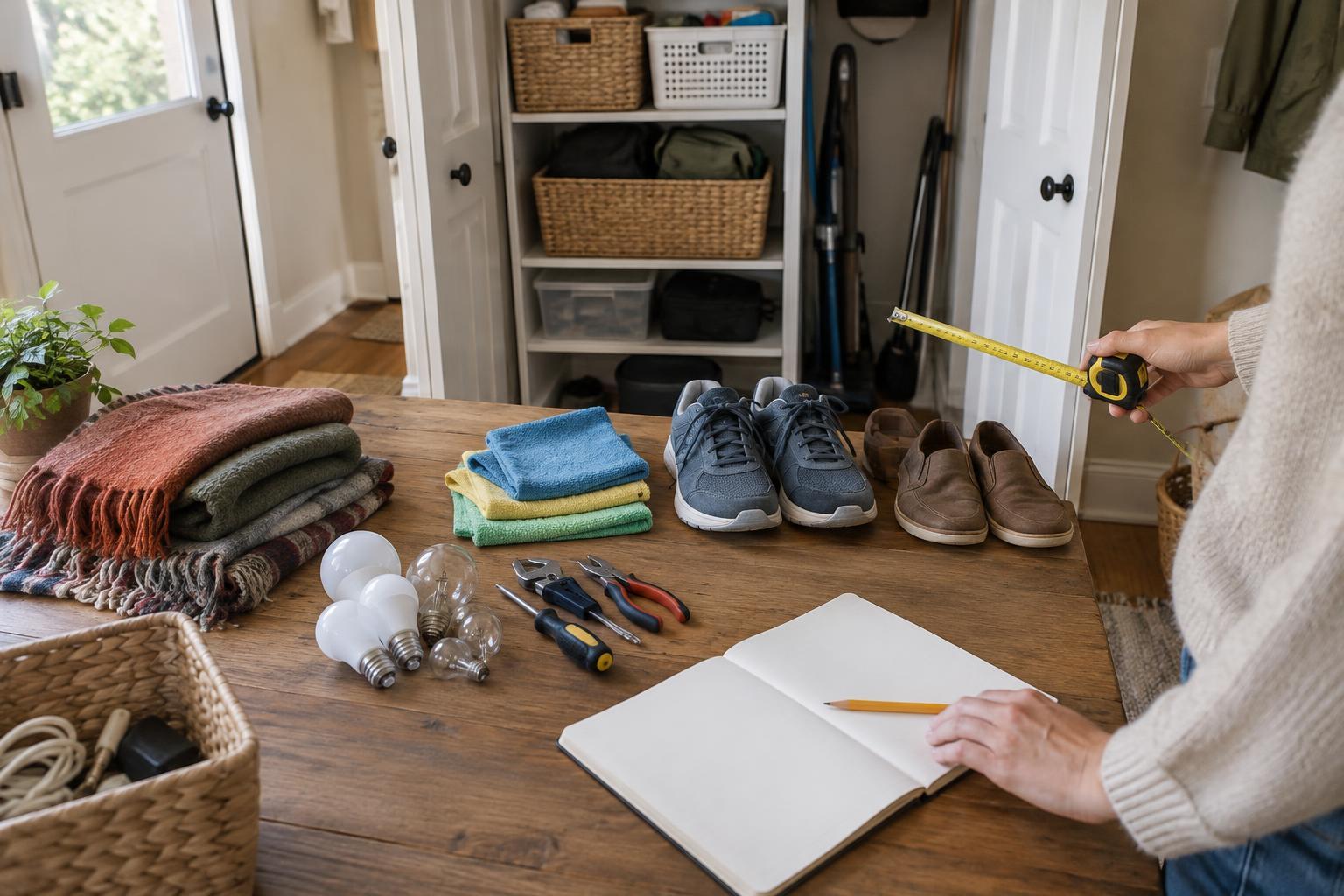
Start with one storage area
An organizer can make a shelf look tidy, but it cannot tell you whether the shelf holds the right things. Before shopping, choose one manageable area to inventory: a linen cupboard, an entryway closet or the drawers around a desk. Working in a defined area makes it easier to finish the job and gives you a useful test for the rest of your home.
Take everything out if the area is small. For a larger space, work shelf by shelf so the room stays usable. As you go, group similar belongings together: spare toiletries, cleaning supplies, seasonal accessories or paperwork. You do not need a detailed spreadsheet. A note on paper or your phone is enough to record each category, its approximate amount and where it currently lives.
Count what stays, not everything you own
Seeing a category in one place makes it easier to spot duplicates and items that no longer serve a purpose. Set aside anything that belongs in another room, then decide what to keep, donate, recycle or discard according to its condition and your local options. Avoid buying containers for things you have already decided not to keep.
For what remains, write down a useful description rather than a perfect count. “Six bulky bath towels and a small stack of washcloths” tells you more about the storage needed than “linens.” Note items that need special treatment, such as bottles that should remain upright, papers that must stay flat or delicate objects that should not be stacked. If other people use the space, ask what they reach for regularly before deciding where those items should go.
Record how and when you use each group
An inventory is most useful when it captures habits as well as quantities. Mark categories as daily, occasional or seasonal. Keep frequently used belongings within easy reach; reserve high shelves and deeper storage for things used less often. If an item repeatedly ends up on the counter or floor, its assigned home may be inconvenient rather than too small.
Also note which belongings tend to move together. Shoe-cleaning supplies might work well in one portable container, while mail may need a shallow landing spot near the door rather than a box in a closet. Think about who needs access, whether they can see or reach the contents, and how easily they can put things away. A clear bin, an open basket and a lidded box can hold the same amount but support different routines.
Measure the space and the awkward items
Once you know what will stay, measure the available storage area. Record its width, depth and usable height, accounting for hinges, pipes, door frames and any clearance needed to pull an organizer out. Measure a few of the largest or most awkward belongings as well. A shelf may appear deep enough for a bin yet leave too little room to grip and remove it.
Check existing shelves and cabinets before planning heavy loads, and follow their stated limits where available. If you rent, note which changes would require permission or wall fixings. Freestanding or removable options may suit the space better than built-ins. Keep your measurements with your inventory so you can compare products against actual dimensions instead of relying on a photograph or a label such as “standard size.”
Buy for the gap, then test the setup
Look at the inventory and identify the specific problem an organizer must solve. Do small items disappear at the back of a deep shelf? Would a divider stop tall objects from falling over? Could moving an existing basket solve the issue without a purchase? Reusing what you have is a low-cost way to test a layout before committing to a matching set.
If you do buy something, start with the few pieces needed for one area. Allow a little room for normal changes in quantity, but do not plan around unlimited future storage. Label containers when their contents are not obvious, and give the setup a short trial during ordinary use. If putting something away takes too many steps, adjust its location or container. The best inventory leads to a storage system that is easy to maintain, not merely satisfying to arrange once.


