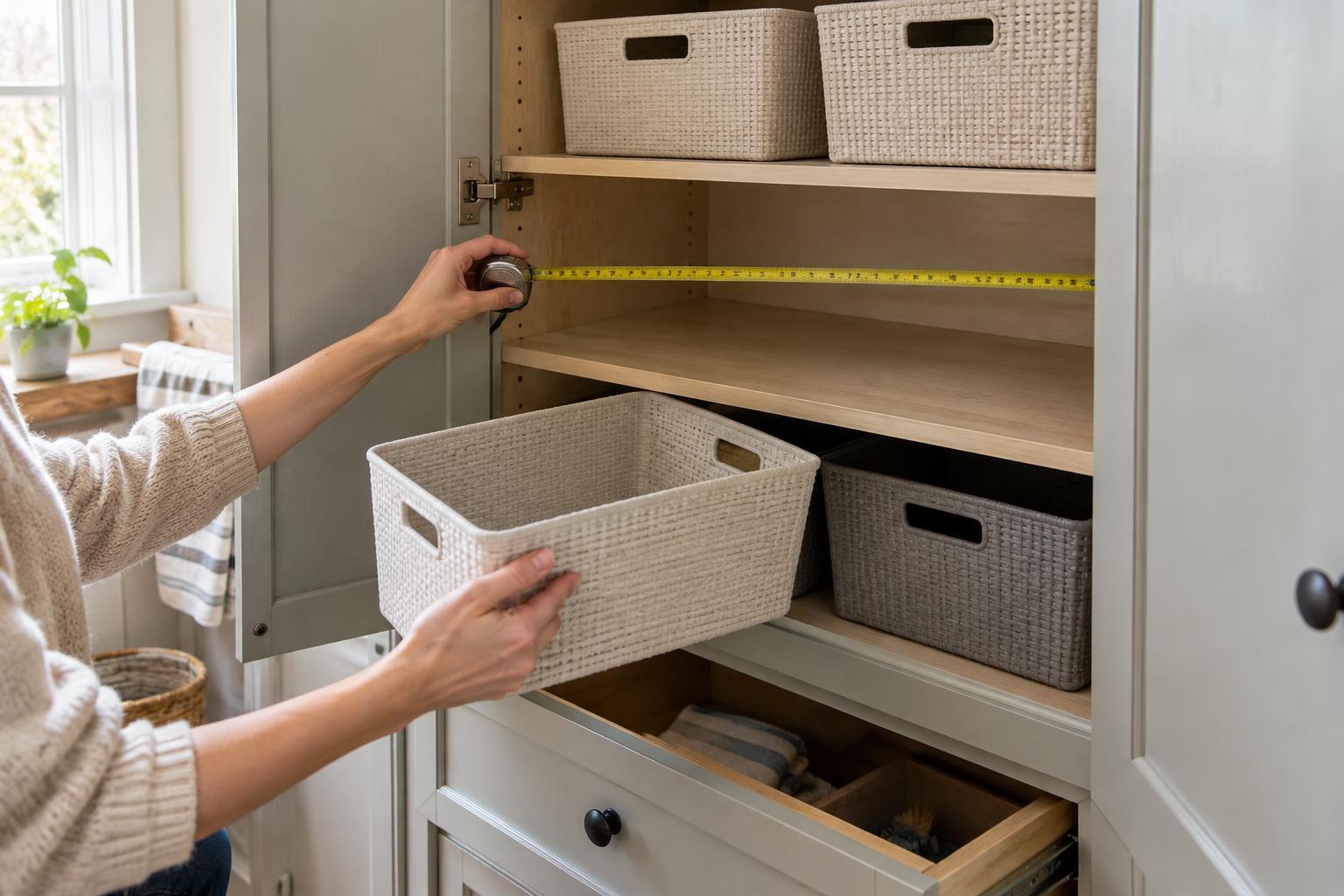
Measure the usable space, not just the opening
A bin can fit inside a cabinet and still be awkward to use. The key is to measure both where it will sit and the path it must take to get there. Keep a tape measure, a note of your dimensions and the bin’s product dimensions together while you plan. Use the same unit throughout, and record width, depth and height separately rather than relying on a single “size” label.
Start by clearing enough space to reach the surfaces you need to measure. For each shelf, drawer or cabinet, note the narrowest clear width, the depth from the front edge to the back obstruction, and the height between the floor or shelf and anything above it. Check more than one point if the space looks uneven. Hinges, shelf supports, plumbing, trim and door hardware can all reduce usable room.
Then consider access. A bin needs enough clearance to slide past a cabinet frame, lift over a drawer side or come off a shelf without scraping the shelf above. Leave a little room beyond the bin’s stated dimensions, especially if you will pull it out often. A close fit may look tidy when empty but become frustrating once the bin has contents.
Shelves: plan for lifting and reaching
On an open shelf, measure the clear width between side panels, the usable depth and the vertical gap to the next shelf. On a shelf inside a cabinet, measure the doorway as well. A bin that fits between the cabinet walls may not pass through a narrower door opening. If a door swings across part of the opening, check the space with the door open as you would normally use it.
Height deserves particular attention. A tall bin may fit under the shelf above but leave no room for your fingers to grip its handles or for a lid to come off. If you plan to pull the whole bin forward before opening it, make sure it can clear the shelf edge and any door. For high shelves, a lighter, easy-to-grip bin is often more practical than one that uses every inch of available height.
Before buying several matching bins, decide whether they will sit side by side or one behind another. Add their outside widths or depths, including any projecting handles, rather than multiplying an advertised capacity. Leave space to grasp each bin independently; otherwise, removing one may mean shifting the entire row.
Drawers: check the opening and the travel
For a drawer, measure the inside floor from side to side and front to back. Then measure the clear height from the drawer floor to the cabinet rail, countertop or drawer above. The sides and back of the drawer may be lower than this clearance, so do not use their height as the only guide. Check for screws, runners or shaped corners that intrude into the space.
Open the drawer as far as its slides allow. Part of the drawer may remain inside the cabinet, making a bin at the back difficult to lift out even though it fits on the floor. Test the route a bin would take: can it be tipped or lifted through the exposed opening without catching on the frame? Shallow bins or dividers may work better than deep containers when the drawer does not extend far.
Also think about how the drawer will feel in daily use. Heavy bins filled with dense items can make a drawer harder to open and may exceed the limits of its hardware. Keep frequently used items toward the front, and avoid packing bins so tightly that their rims rub against one another when the drawer moves.
Cabinets: account for frames, doors and obstacles
Base and wall cabinets often have different interior and entry dimensions. Measure inside the cabinet, then measure the clear opening between face-frame edges or door hinges. For a double-door cabinet, check whether a center stile divides the entry. If a bin must turn to pass through, consider whether the available depth gives you room to make that turn.
Under a sink, take separate measurements for each usable area rather than treating the cabinet as one rectangle. Pipes, disposal units and supply lines may leave an irregular footprint. A short, narrow bin beside an obstruction can be easier to use than a large bin pushed behind it. Keep access to plumbing and shutoffs unobstructed.
If the cabinet has adjustable shelves, set them at the height you intend to use before taking final measurements. A change in shelf position can solve a clearance problem, but check that the revised spacing still lets you reach what sits above or below.
Compare bin dimensions and test the fit
When shopping, look for outside dimensions, not just volume or the dimensions at the base. Tapered bins may be wider at the rim, while handles, latches and lids can add to their footprint. If dimensions are unclear, measure the bin at its widest and tallest points. For a lidded bin, decide whether you need to open it in place or can remove it first.
Make a simple note for each location: usable width, depth, height, entry opening and any obstacle. Compare those numbers with the bin’s outside measurements in the orientation you intend to use. If possible, try one bin before committing to a full set. Put something inside it, open the door or drawer, and practice removing and replacing it. The right fit leaves storage space organized without making the stored items harder to reach.


