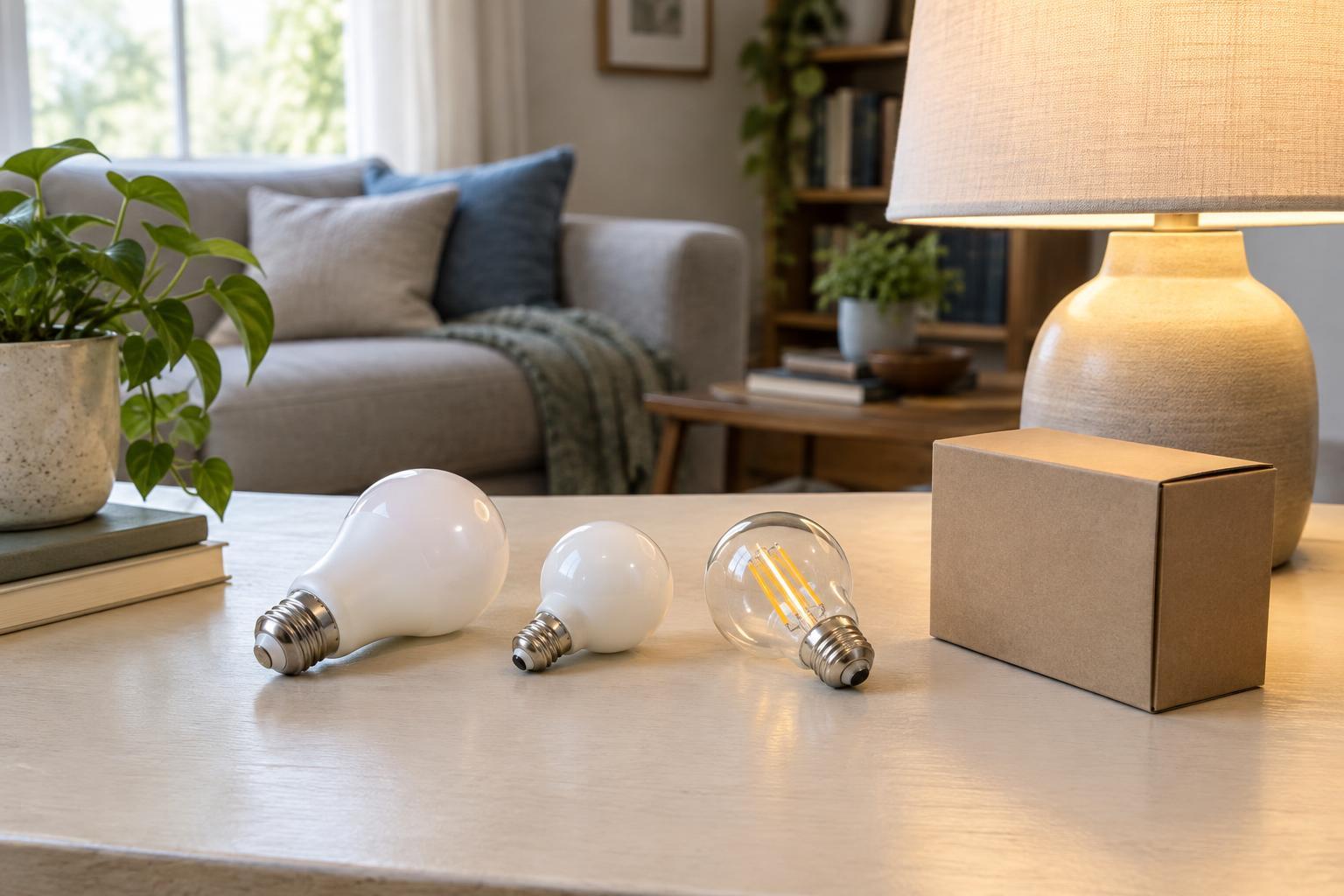
Start with lumens for brightness
When you want a room to feel brighter, look for lumens. A lumen rating describes the amount of visible light a bulb produces. A higher number generally means a brighter bulb, although a shade, diffuser or narrow beam can change how bright the light feels in a particular spot.
As a rough starting point, a bulb around 450 lumens may suit a small table lamp, while one around 800 lumens can work for many general-purpose lamps. These are guides, not rules. A reading light aimed at a book has a different job from a ceiling fixture intended to light a whole room. Consider where the light lands, how many bulbs the fixture holds and whether other lights will be on at the same time.
If you are replacing a bulb and liked its brightness, use its lumen rating as your reference. If the room felt dim, choose more lumens or add another source of light rather than relying on a familiar wattage printed on the package.
Read watts as energy use, not brightness
Watts tell you how much electrical power a bulb uses while it is on. They are not a reliable way to compare brightness across different bulb types. An LED can produce a similar amount of light to an older incandescent bulb while using fewer watts. Packaging may include an incandescent-equivalent wattage to help with comparison, but the actual wattage and lumen rating are more useful.
For a simple picture of running cost, divide the bulb’s watts by 1,000, then multiply by the hours you expect to use it. An 8-watt bulb used for 1,000 hours consumes about 8 kilowatt-hours of electricity. To estimate a cost, multiply that figure by the price per kilowatt-hour on your electricity bill. Your actual use matters: a hallway bulb switched on briefly each day has a different impact from a lamp used for hours every evening.
Also check the fixture’s maximum permitted wattage. That limit is about safe power use in the fixture; it is not a brightness target. Follow the fixture’s instructions even when choosing an efficient bulb.
Treat lifespan as an estimate
A label’s rated lifespan is usually expressed in hours. It is a useful comparison between bulbs, but it is not a promise that every bulb will last that long. To put the number in everyday terms, divide it by your estimated hours of use per day, then by 365. A bulb rated for 15,000 hours and used for three hours a day works out to roughly 14 years on paper.
Real results can differ. Heat, the fixture design, frequent switching and the quality of the bulb may affect its working life. LED bulbs can also become dimmer over time rather than stopping suddenly. If a bulb will be difficult to reach or replace, a longer rated life may be worth considering, but make sure the bulb is approved for the fixture first. In particular, check the package before using an LED in a fully enclosed fitting, where heat can build up.
Check the details that shape the light
Lumens, watts and lifespan narrow the choice, but they do not describe the whole experience. Color temperature, measured in kelvins (K), indicates whether white light looks warmer or cooler. Lower numbers tend to look warm and yellowish; higher numbers look cooler and more bluish. For a visually coherent room, bulbs used together often look better when their color temperatures match.
The label may also show a color rendering index, or CRI, which describes how colors appear under the light compared with a reference source. It can help when choosing light for a kitchen counter, artwork or a place where you select clothes. If you use a dimmer, look for a bulb marked dimmable and check that it is compatible with your dimmer. A non-dimmable bulb may not work as intended.
Finally, confirm the bulb’s base, shape and physical size. A bulb can have the right brightness but still fail to fit under a shade or inside a compact fixture. Some packages also specify whether the bulb is suitable for damp locations or outdoor use.
Choose for the fixture and the task
Before shopping, note the base type and fixture limits, then decide what the light needs to do. Choose a lumen level for the task, compare actual watts if energy use matters to you, and use rated lifespan to weigh replacement effort. Finish by checking color temperature, dimming requirements and any restrictions on where the bulb can be used.
For a multi-bulb fixture, remember that the bulbs work together: several moderate-lumen bulbs may provide plenty of light. For a desk or reading chair, placement can matter as much as the number on the box. Reading the label in this order helps you avoid buying a bulb that is efficient and long-lasting but wrong for the space.


