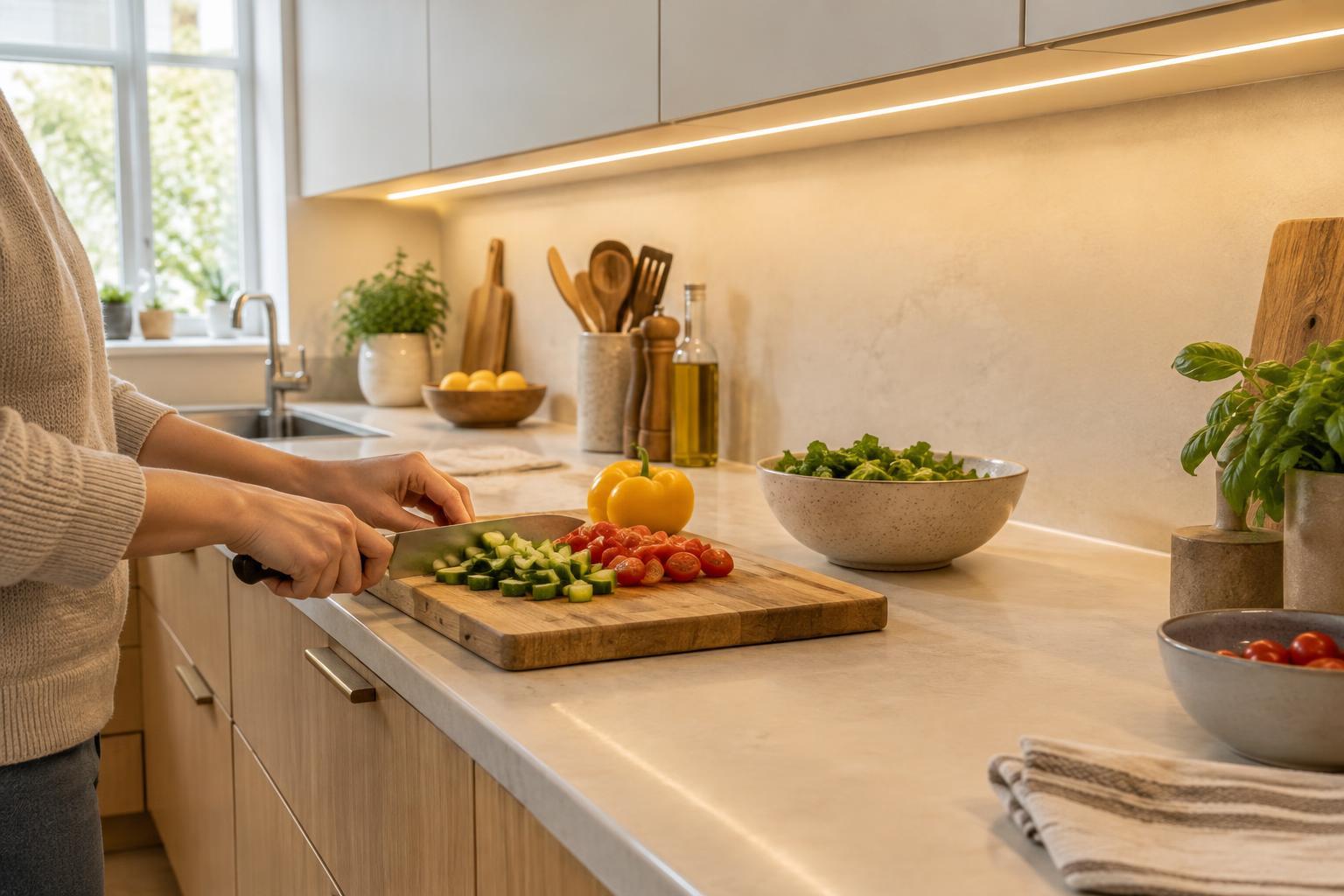
Start with the shadow, not the fixture
A kitchen can look bright while its counters remain difficult to use. Ceiling lights often sit behind a person standing at the worktop, so their body blocks the light just where they are chopping, measuring, or reading a label. Before buying anything, stand at each preparation area in your usual position. Notice where your hands cast shadows and which parts of the counter look dim.
Prioritize the surfaces where you actually work. A long run of counter may need continuous light, while a short section beside the hob or sink may need its own fixture. Decorative lighting can make the room feel welcoming, but task lighting has a narrower job: it should make the work surface and the objects on it easy to see without making you squint.
Put the light in front of your hands
Under-cabinet lighting is often effective because it shines onto the counter from in front of the person working there. Mounting a linear fixture toward the front edge of an upper cabinet generally helps the light reach the usable area of the worktop. If it sits too far back, it may brighten the backsplash while leaving the front of the counter in shadow. A cabinet lip or a suitable diffuser can help keep the light source out of direct view.
For an even result, consider a continuous LED strip or closely spaced linear fixtures rather than a few isolated points of light. Separate pucks can work well in small areas, but they may create bright circles with darker gaps between them. At corners, beside tall cabinets, and under shelves of different depths, check the coverage from your normal working position rather than assuming one placement will suit the whole kitchen.
Balance brightness with comfort
More light is not automatically better. A bare LED strip reflected in a glossy countertop can be uncomfortable even when the counter is well illuminated. A diffused fixture, careful placement, or a small change in angle may soften that reflection. Test a proposed position by temporarily holding a portable light beneath the cabinet and looking at the surface both while standing and while seated nearby.
Aim for a consistent appearance across the kitchen. Choosing fixtures with a similar color temperature helps prevent one section of counter from looking noticeably warmer or cooler than the next. If you want task lighting for detailed work and gentler light later, dimming can offer both without adding another row of fixtures. Check that the light, driver, and dimmer are compatible before buying them together.
Choose a setup that fits the kitchen
For a renter or a modest refresh, plug-in under-cabinet lights can avoid permanent electrical changes. Look at the route from the fixture to the outlet before choosing a product: a visible cord crossing a backsplash can be distracting and may get in the way of cleaning. Adhesive-mounted options are convenient, but their hold depends on the surface and they may leave marks when removed. Battery-powered lights are useful where an outlet is unavailable, provided you are comfortable charging or replacing batteries.
Homeowners planning a larger update may prefer a hardwired setup for a cleaner appearance and more convenient switching. Decide where the switch should go before installation; a perfectly placed light is less useful if turning it on is awkward. For any work involving household wiring, use a qualified professional rather than treating it as a simple fixture swap.
Test the result during real tasks
Once the lights are in place, try them while preparing a meal, wiping the counter, and working at the sink. Move a cutting board along the surface to find any dark patches. If a fixture is adjustable, small changes to its angle or position may solve a shadow without requiring a brighter bulb or an additional light.
Keep the fixtures clean, too. Grease and dust on a diffuser can make the light look uneven over time. The goal is not to make every surface equally bright; it is to give your hands and tools clear, comfortable light where you use them most, while letting the rest of the kitchen retain some visual depth.


