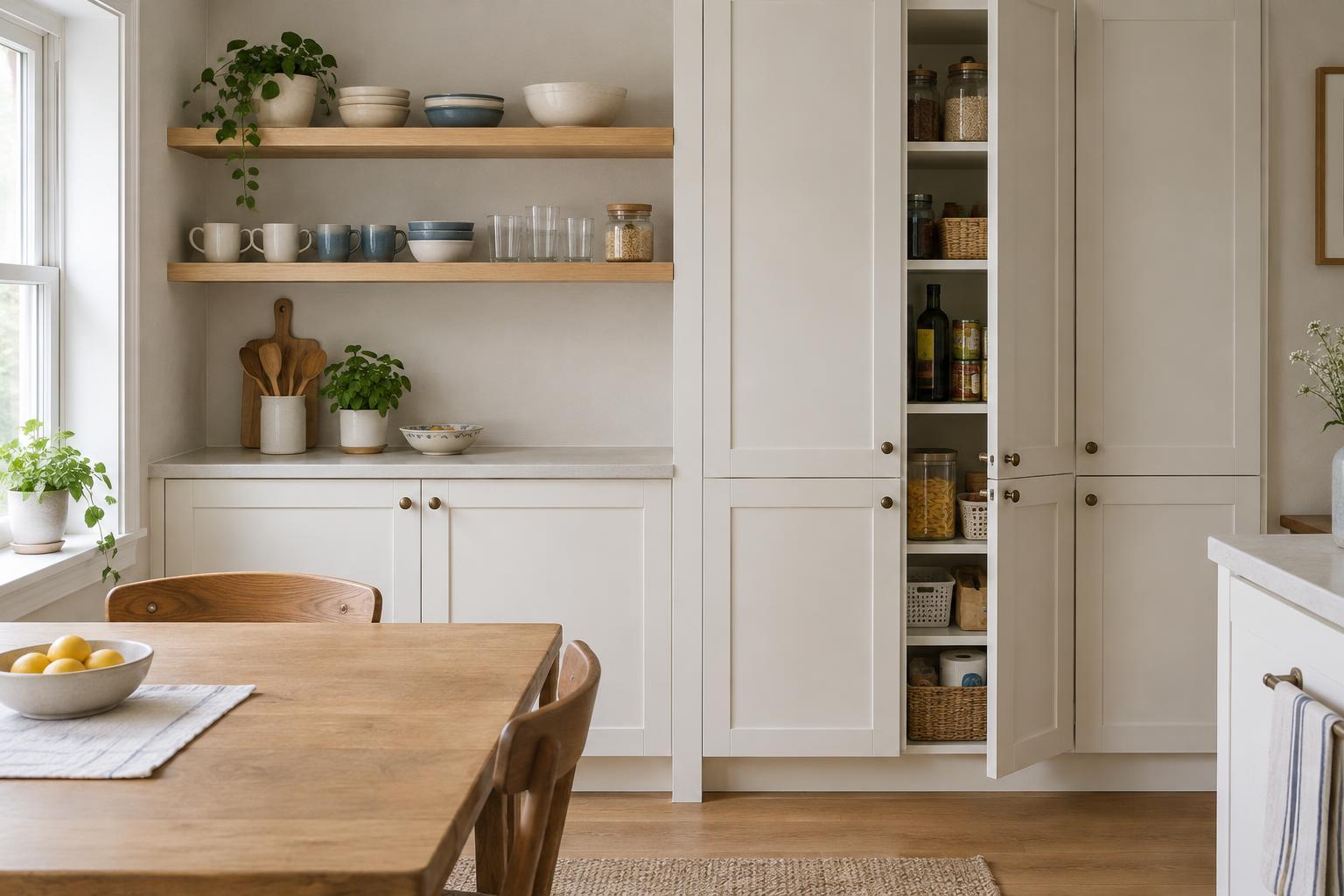
Start with the items, not the furniture
The best storage choice depends less on the room than on what you need to put away. Before choosing shelves or cabinets, sort everyday items into three groups: things you reach for often, things you use occasionally, and things you would rather not see. A mug used every morning has different storage needs from a stack of spare mugs. The same distinction applies to toiletries, office supplies, toys and cleaning products.
Open shelves make contents visible and easy to grab. Closed cabinets give mixed items a quieter backdrop and help keep dust and splashes off what is inside. Neither is automatically more organized: an overfilled cabinet can be hard to use, while a carefully arranged shelf can make a daily routine simpler. The aim is to give each item a place that matches how it is used.
When open shelves work well
Choose open shelves for a small number of items that are used regularly and are easy to put back. In a kitchen, that might mean everyday plates and glasses near the dishwasher. In a workspace, it could mean reference books and a few supplies beside the desk. Being able to see everything can also help you notice when something is running low or has been left in the wrong place.
Visibility comes with upkeep. Exposed items and shelf surfaces may need more frequent cleaning, particularly near cooking areas or in dusty rooms. Shelves can also look crowded long before they run out of physical space. Leave room around groups of objects, and use a few consistent containers for small items rather than lining up many loose pieces. Put heavy or breakable objects on sturdy shelves at a comfortable reaching height, not where they are difficult to lift down.
Open storage is easiest to live with when its contents form part of an existing routine. If you would have to rearrange a display each time you unload groceries or put away laundry, the shelf is probably doing too much decorative work and not enough practical work.
When closed cabinets earn their space
Cabinets are useful for supplies with varied packaging, occasional-use equipment, and anything that makes a room feel busy when left in view. Doors can make a compact room appear calmer without requiring every stored object to match. They are also helpful where contents need some separation from everyday dust or splashes, although a cabinet is not a substitute for suitable storage conditions for items that require them.
A door only improves storage if you can find what is behind it. Give frequently used items the most accessible shelves, and use shallow bins or simple labels to keep categories together. Avoid placing small essentials behind large objects. Before adding a cabinet, check the space needed to open its doors and stand in front of it; a unit that blocks a walkway when in use may be less convenient than a slimmer alternative.
Build a mix around your routines
Many rooms benefit from both types of storage. A few open shelves can hold daily essentials, while a nearby cabinet handles refills, tools and less-used items. In a living room, for example, books and a lamp might sit on open shelving, with games and cables behind doors. In a bathroom, an accessible shelf can hold a couple of daily products while backup supplies stay out of sight.
Think about who uses the space. Children may find open, low storage easier to use for toys, while small loose parts may be better contained in a bin. If several people share a room, visible categories and easy-to-reach locations can make putting things away more straightforward. Store items that need to be kept away from children or pets in an appropriately secure place; an ordinary open shelf or cabinet door may not be enough.
You can test the balance before buying furniture. Clear one existing shelf and use it only for items you reach for daily. Move everything else into a drawer or cabinet for a week or two. If the open shelf stays useful without becoming a drop zone, it may be worth expanding. If it quickly fills with unrelated things, more concealed storage or clearer item categories may serve you better.
Make the choice fit the room and budget
Measure the items as well as the available wall or floor space. Shelf depth should suit what it holds without inviting objects to disappear behind one another. For cabinets, consider adjustable shelves and how easily you can reach the back. Whatever you choose, follow the furniture maker’s installation guidance, including any appropriate wall fixing for tall units or loaded shelves.
A change does not have to mean a full renovation. Renters can reorganize an existing bookcase with matching bins or use a freestanding cabinet where space allows. Homeowners might replace selected cabinet doors with open storage, but it is worth trying a small area first. Start with the storage that reduces a daily frustration; visual coherence is easier to achieve when the arrangement also works.


