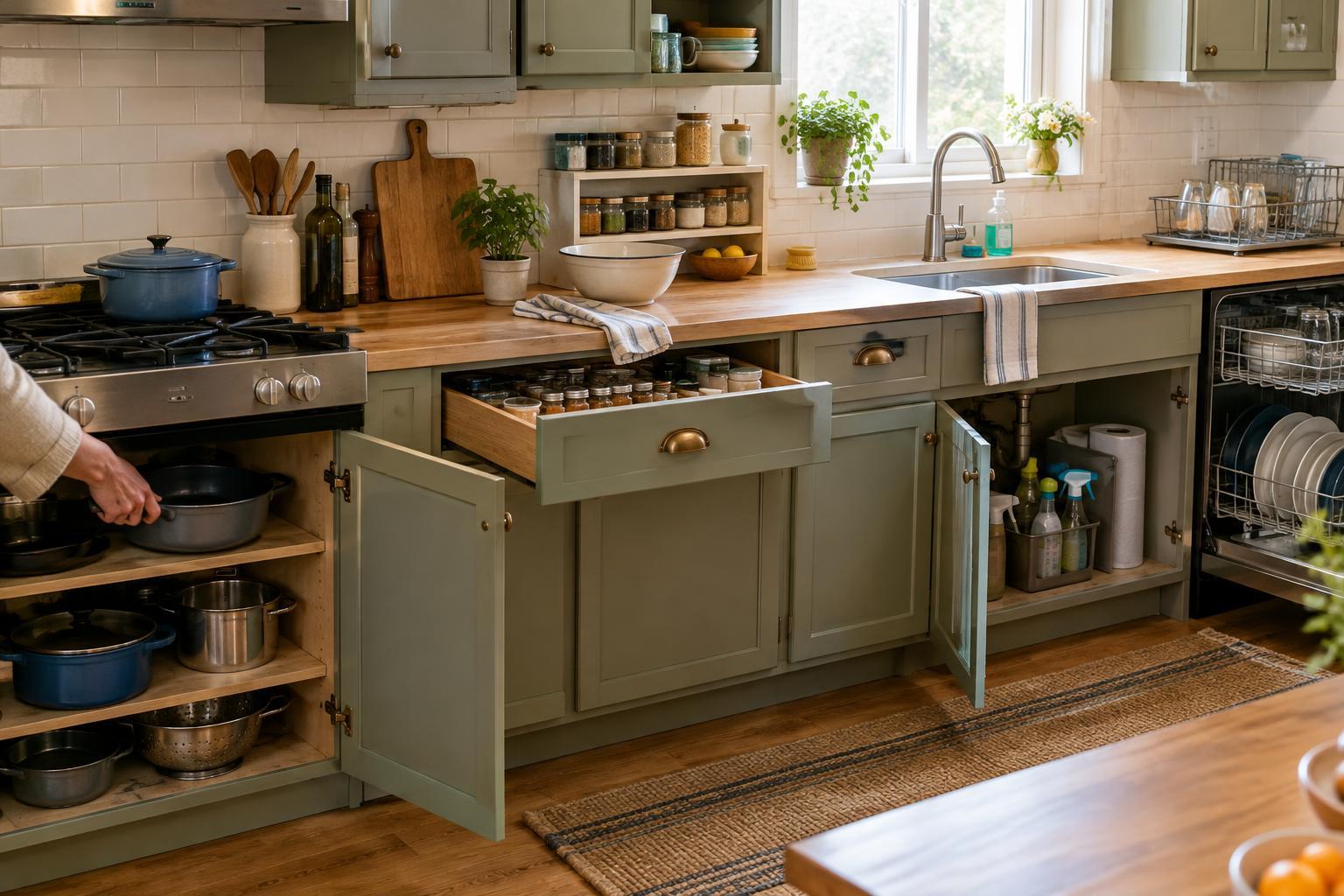
Map the work before moving anything
An organized kitchen does not need every cabinet to look identical. It needs the things you use together to be reasonably close together. Before emptying shelves, walk through a familiar meal: take out ingredients, prepare them, cook, serve, clear the table and wash up. Notice where you cross the room to retrieve a tool or put one away. Those repeated trips point to useful changes.
Sketch a quick cabinet map or label each space on a piece of paper. Mark the main prep surface, stove, sink and dishwasher, if you have one. Then group cabinet contents by task rather than by shape. A large bowl used for mixing may belong closer to measuring cups than to serving bowls. Keep the plan flexible: in a small kitchen, one cabinet may serve several tasks, while a spacious kitchen may allow each task its own area.
Give cooking supplies convenient homes
Place everyday prep tools near the surface where you chop and mix. That might mean cutting boards in a narrow lower cabinet, mixing bowls on a nearby shelf and measuring tools in the closest drawer. Put the items you reach for most often at comfortable heights, leaving high or awkward shelves for lighter things used less often. Heavy pots and appliances are generally easier to handle from sturdy lower storage.
Near the stove, reserve accessible space for frequently used pans, lids and cooking utensils. You do not need to store every pan beside the burner; keep the reliable daily pieces closest and move occasional equipment farther away. A vertical rack can separate baking sheets or cutting boards if the cabinet has enough clearance. For deep cabinets, a tray or bin can gather related small items, but check that you can lift it out without disturbing everything around it.
Food storage works best when it reflects how you prepare meals. Keep commonly used dry ingredients together and easy to see, with labels that identify contents when packaging is no longer visible. Store food according to its package directions, and avoid placing it where heat or moisture from cooking could be a problem. Before buying containers, try rearranging existing packages and removing empty or stale items; that may create all the space you need.
Plan the route from serving to washing up
Cleanup becomes simpler when dishes have homes near the place they are washed or unloaded. If possible, put everyday plates, bowls and glasses within a short trip of the dishwasher or drying area. Choose shelves that everyone who regularly puts dishes away can reach comfortably. Serving pieces used only for guests can take a less convenient spot, leaving the easiest shelves for daily items.
Give food-storage containers a clear area near the point where you pack leftovers. Nest containers only when you can still find matching lids; a small upright lid holder or shallow bin may help. Keep a modest amount of open space for an extra container or dish, since a cabinet filled to its edges is harder to maintain.
Under the sink, use storage only for items suited to that location and leave access to plumbing. Keep cleaning products in their original labeled containers and follow their storage directions, especially if children or pets can reach the cabinet. A separate caddy for sponges, cloths and dish brushes can make it easier to wipe the shelf and notice a leak.
Use simple supports, not a new system for everything
Small organizers are most useful when they solve a specific problem. A shelf riser can make short stacks of cups easier to reach. A non-slip liner may steady lightweight items on a smooth shelf. Removable bins can help renters divide a broad cabinet without altering it. Measure the interior width, depth and door clearance before purchasing anything, and check that an organizer does not block a hinge or make an item difficult to lift.
Avoid creating so many categories that putting things away becomes a chore. One bin for baking supplies may be more practical than several tiny bins for every ingredient. If multiple people use the kitchen, choose locations they can remember and labels they can read at a glance. The best arrangement is one that works during a busy week, not only immediately after a thorough tidy.
Test the layout and adjust it
Move one task group at a time, then cook and clean with the new arrangement for several days. If you keep reaching toward an old location, ask whether the new home is inconvenient or simply unfamiliar. Move an item back if the change adds steps. Cabinet organization is a working layout, not a permanent display.
Recheck crowded areas when routines change. A new cooking habit may make a once-occasional tool essential; an appliance you rarely use may be taking prime space. Keep the principle simple: daily items should be easy to take out and easy to put away, and related tasks should require as little backtracking as your kitchen allows.


