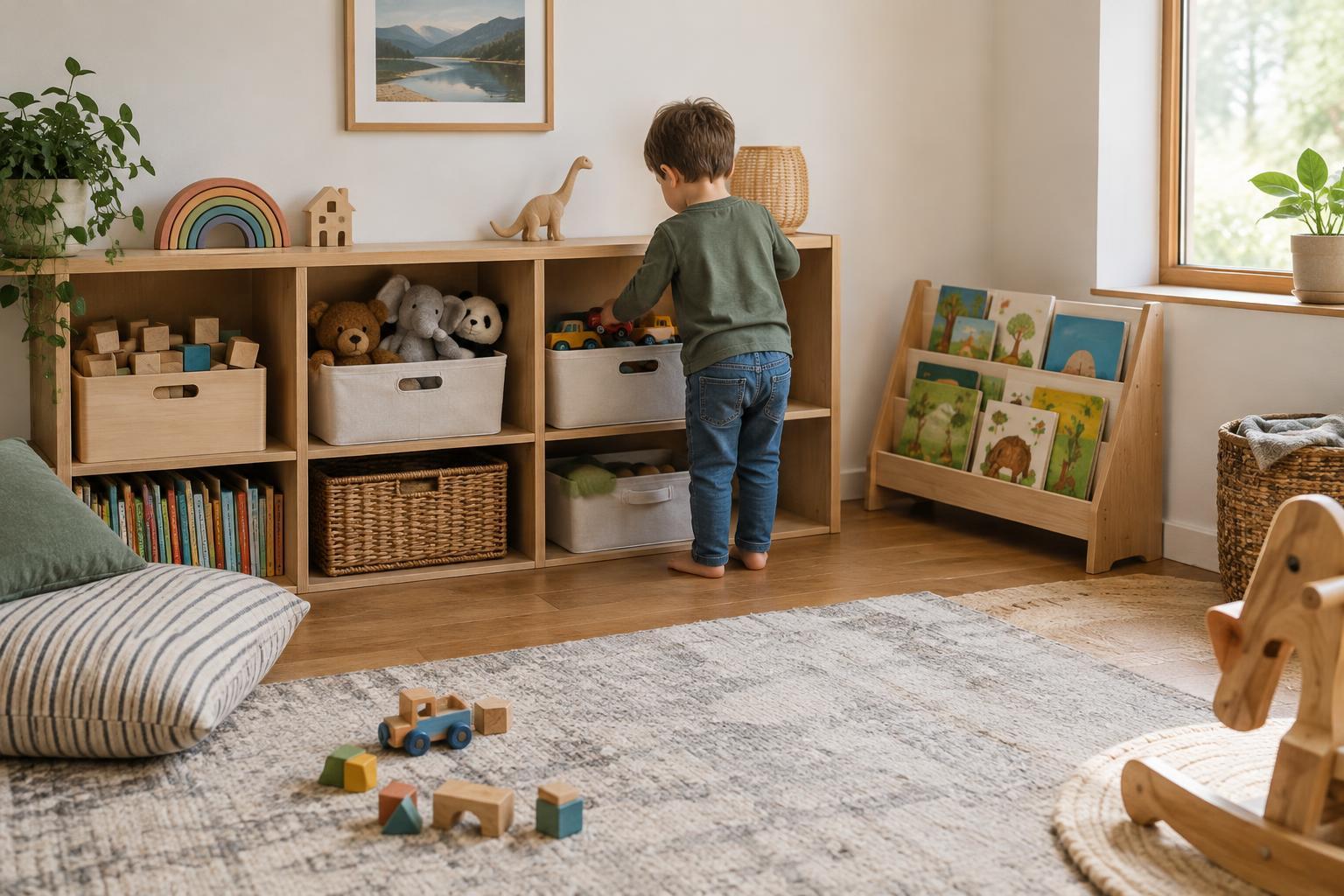
Start with the child’s point of view
Toy storage is often designed around how a room looks after cleanup. For children, the more useful question is whether they can find a toy and return it without asking for help. Sit or crouch at their height and look at the play area. Which containers can they reach? Can they see what is inside? Do they have to move several things before putting one thing away?
Keep the toys used most often on low, accessible shelves. Place occasional-use items higher up for an adult to retrieve. If toys are played with in more than one room, a small basket in each play area may be more practical than expecting every item to return to one distant shelf.
Give each type of toy an easy home
Broad categories are usually easier to maintain than detailed sorting. Blocks can go in one bin, pretend-play food in another and soft toys in a basket. A child who is just learning to tidy may do better with a few obvious destinations than a shelf full of narrowly defined compartments. If a category overflows, it may need a larger container, a second location or fewer items in regular use.
Choose open bins or containers with lids that are easy to remove. A toy should be no harder to put away than it is to take out. Shallow bins help children spot what they want without emptying everything onto the floor; deeper baskets can work well for bulky items that do not need careful sorting. Leave a little spare room in each container so cleanup does not depend on arranging every piece perfectly.
For toys with many small components, keep the pieces together in one container and place it where an adult can help if needed. Follow the toy’s age guidance, especially when younger children share the space.
Make the layout clear without making it rigid
A low shelf can give each bin a visible place to return to. In a small room, storage under a bed or beside a sofa may work just as well, provided a child can pull the container out and put it back comfortably. Floor space matters too: leave enough room in front of storage for a child to stand, choose and tidy without stepping over toys.
Labels can make destinations easier to remember. Pair a simple word with a picture or a photo of the contents, then put the label where it is visible from the child’s height. The label does not need to match every item exactly. Its job is to answer the quick question, “Where does this go?”
Check that shelves and containers suit the child’s abilities and the room. Avoid unstable stacks or heavy bins that a child has to lift overhead. Secure furniture that could tip if climbed, and choose storage with closures that will not make access or cleanup difficult.
Build cleanup into the way toys are used
Even a well-planned system needs a routine. Try putting away one activity before starting another, or allow a short reset before a meal or bedtime. A specific prompt such as “Put the blocks in their bin” is easier to act on than “Clean the room.” At first, tidy alongside the child so they can learn the categories and the steps.
Keep the task small enough to finish. If a full cleanup repeatedly takes too long, consider storing some toys out of the regular play area and swapping them in occasionally. This is not about creating a perfect room; it is about making the amount left to manage fit the time and attention available.
Adjust the system as play changes
Watch what happens over a few weeks. Toys consistently left on the floor may need a closer home. A bin that is always emptied to find one favorite item may be too deep or too crowded. If children combine toys from different categories in imaginative play, the storage can reflect that rather than forcing a strict separation.
Ask children where they think things should go, then test their suggestions where practical. A system they understand and can use is more valuable than one that looks tidy only when an adult maintains it. Start with a few reachable containers, change what is not working and let the storage grow with the child.


